

Ever typed a word, stared at it, and thought… that doesn’t look right? If you’ve found yourself wondering offerred or offered, you’re not alone. This is one of those tricky spelling dilemmas that catches even confident writers off guard.
In this guide, we’ll clear up the confusion once and for all. You’ll learn the correct spelling, why it works, and how to avoid making the same mistake again. By the end, you’ll never second-guess it again.
Offerred or Offered: Which Is Correct?
Let’s settle it quickly:
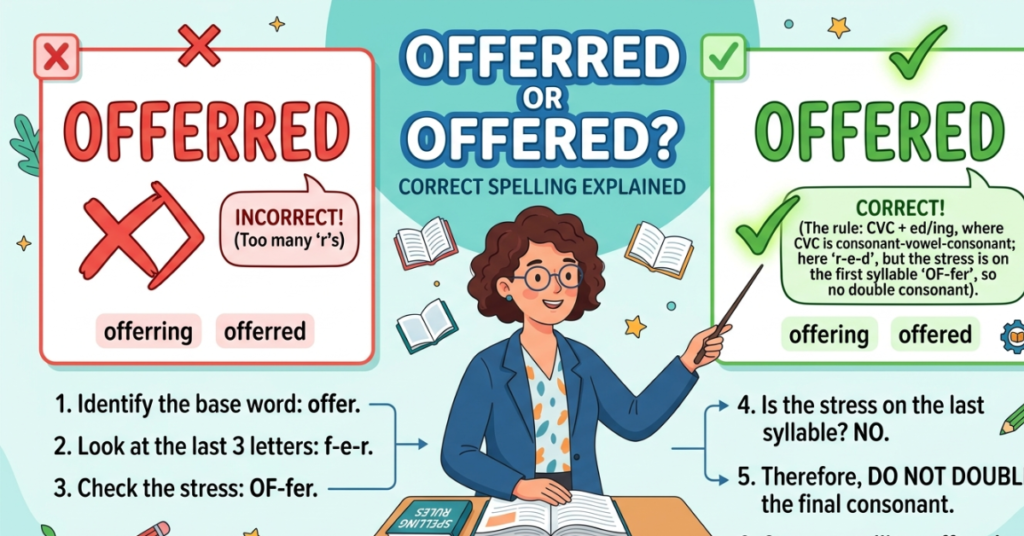
The correct spelling is “offered.”
“Offerred” is incorrect.
If you’re asking “is it offerred or offered?”, the answer is simple—“offered” is the only accepted spelling in both American and British English.
Why “Offered” Is Correct
To understand this, we need to look at how English handles verb forms.
The word “offered” comes from the base verb offer. When forming the past tense, we typically add -ed.
Here’s the breakdown:
- Base verb: offer
- Past tense: offer + ed = offered
Unlike some verbs, offer does not require doubling the final “r.”
When Do We Double Letters in English?
This is where many people get confused and end up writing offerred.
You usually double the final consonant when:
- The word ends in a consonant-vowel-consonant pattern
- The stress is on the final syllable
Example:
- prefer → preferred (stress on “fer”)
- admit → admitted
But:
- offer → offered (stress is on the first syllable: OF-fer)
That’s why offerred or offered spelling often trips people up—the rule depends on pronunciation, not just letters.
Offerred or Offered UK: Is There a Difference?
A common question is whether British English changes things.
The answer: No difference at all.
Whether you’re writing in the UK or the US, the correct form is still “offered.”
So if you’re searching for offerred or offered UK, remember:
- British English offered
- American English offered
- “offerred” incorrect everywhere
Examples of “Offered” in Sentences
Seeing it in context helps lock it in.
- She offered to help with the project.
- They offered a discount to new customers.
- He offered his seat to the elderly passenger.
Notice how natural “offered” looks once you’re used to it.
Common Mistakes to Avoid
Here are a few pitfalls people often run into:
- Writing offerred because it “looks balanced”
- Assuming all verbs double consonants
- Overthinking simple past tense forms
Quick tip:
If the stress isn’t on the last syllable, don’t double the final consonant.
Easy Trick to Remember
Here’s a simple memory hack:
Think of “offer” as already complete—you’re just adding -ed, nothing extra.
No doubling, no complications. Just:
offer → offered
FAQs
1. Is it offerred or offered?
The correct spelling is offered. “Offerred” is a common misspelling and should be avoided.
2. Why isn’t the “r” doubled in offered?
Because the stress in offer is on the first syllable, English rules do not require doubling the final consonant.
3. Is “offerred” ever correct?
No, “offerred” is not correct in any form of English.
4. Does British English use “offerred”?
No. Both UK and US English use offered as the correct spelling.
5. How can I remember the correct spelling?
Just remember: offer + ed = offered. No extra letters needed.
Conclusion
The confusion around offerred or offered is more common than you might think, but the rule is straightforward once you understand it. The correct spelling is always “offered,” regardless of region or context.
By keeping an eye on stress patterns and remembering simple verb rules, you can avoid this mistake entirely.
Next time you pause mid-sentence wondering “offerred or offered spelling?”, you’ll know exactly what to write—and why.