
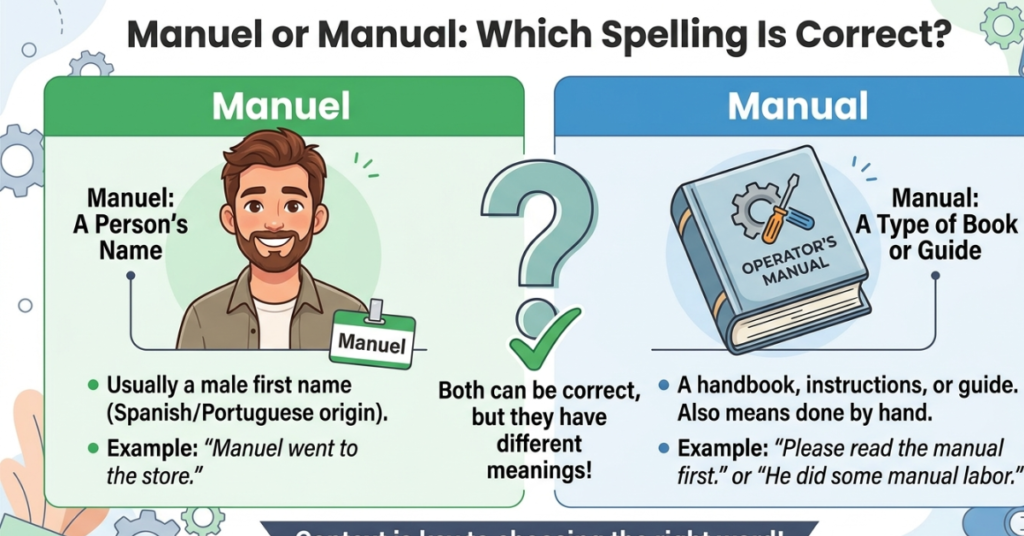

If you’ve ever paused mid-sentence wondering “is it manuel or manual?”, you’re not alone. This common spelling confusion trips up students, writers, and even professionals. The truth is simple—but understanding why makes it stick.
In this guide, we’ll break down the difference between these two words, explain how to use the correct form, and explore related meanings like manual car and manual book. By the end, you’ll never second-guess yourself again.
Manuel or Manual: Which Is Correct?
Let’s clear this up right away:
- Manual is the correct word in most contexts.
- Manuel is usually a name, not a common English word.
So when asking “manuel or manual which is correct?”, the answer depends on what you mean—but for everyday usage, manual is almost always right.
What Does “Manual” Mean?
The word manual has several meanings depending on context. It generally refers to something done by hand or a guide that explains how something works.
Common Uses of “Manual”
- Instructional Guide (Manual Book)
- Example: “Check the manual before using the machine.”
- This is often called a manual book or user guide.
- Physical or Hand-Based Work
- Example: “Manual labor requires physical effort.”
- Manual Transmission (Manual Car)
- A manual car is one where the driver shifts gears themselves.
What Does “Manuel” Mean?
Unlike “manual,” Manuel is typically:
- A first name (common in Spanish and Portuguese-speaking countries)
- Occasionally a surname
Example:
- “Manuel is learning how to drive.”
So if you’re writing about instructions, work, or vehicles, using manuel would be incorrect.
Manuel or Manual Difference Explained
Here’s a quick comparison to make things crystal clear:
| Word | Meaning | Usage Example |
| Manual | Guide, hand-operated, physical | “Read the manual before assembling.” |
| Manuel | A person’s name | “Manuel called earlier today.” |
This simple distinction answers the common question: “manuel or manual difference”.
How to Spell Manuel or Manual Correctly
If you’re unsure how to spell manuel or manual, use this quick trick:
- Manual = “Hand” (think “man”)
- Manuel = A person
Memory Tip:
If you’re referring to instructions or something mechanical, go with manual.
Manual Car vs Automatic: Quick Insight
The term manual car often appears in this discussion, so here’s a quick breakdown:
Manual Car
- Requires gear shifting by the driver
- Better control over speed and power
- Often more fuel-efficient
Automatic Car
- Changes gears automatically
- Easier to drive, especially in traffic
So when writing about vehicles, always use manual car, not manuel car.
Common Mistakes to Avoid
Here are a few frequent errors people make:
- Writing “manuel book” instead of manual book
- Using “manuel” when referring to instructions
- Mixing up spelling in formal writing
Quick Fix:
If it’s not a person’s name, it’s probably manual.
FAQs
1. Is it manuel or manual?
In almost all cases, manual is correct. “Manuel” is typically a name.
2. Manuel or manual which is correct for instructions?
The correct word is manual, as in a user manual or guide.
3. How to spell manuel or manual correctly?
Use manual for objects, guides, or processes. Use Manuel only for names.
4. What is a manual car?
A manual car is a vehicle where the driver manually changes gears using a clutch and gear stick.
5. What is a manual book?
A manual book is an instruction guide that explains how to use or operate something.
Conclusion
The confusion between manuel or manual is common—but easy to fix once you understand the difference. Manual is the correct term for guides, physical work, and vehicles, while Manuel is simply a name.
Next time you hesitate, remember: if it’s about instructions or mechanics, stick with manual. It’s a small detail that makes a big difference in clear, professional writing.
If you found this helpful, consider exploring more grammar tips to sharpen your writing even further.