
Ever found yourself wondering whether to write catchup or catch up? You’re not alone. It’s one of those small language quirks that can trip up even confident writers, especially in emails, meetings, and casual chats.
In this guide, we’ll break down is it catchup or catch up, explain when each form is correct, and show you how to use them naturally in everyday situations. By the end, you’ll never second-guess it again.
Catchup or Catch Up: What’s the Difference?
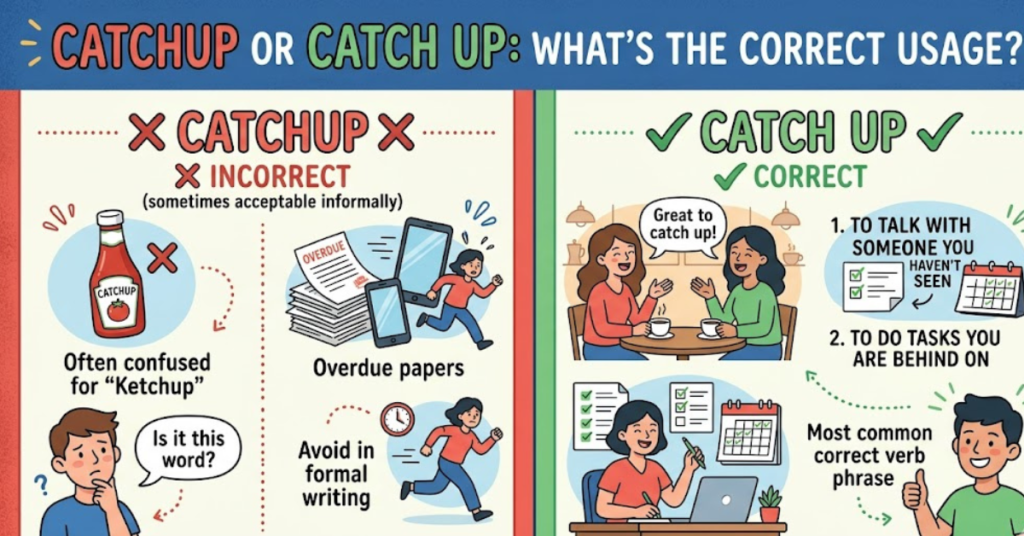
Let’s clear this up right away: “catch up” is the standard and correct form in most cases.
“Catch up” (verb phrase)
Use catch up as a verb when you’re talking about reconnecting, updating, or reaching the same level as someone else.
Examples:
- Let’s catch up this weekend.
- I need to catch up on my emails.
- She’s trying to catch up with her classmates.
“Catchup” (one word)
“Catchup” is not commonly accepted in modern English. If you see it, it’s usually a misspelling or informal variation. (And no—it’s not the same as ketchup, the condiment.)
What About “Catch-Up” With a Hyphen?
Here’s where things get interesting.
“Catch-up” (noun or adjective)
Use catch-up (with a hyphen) when it functions as a noun or describes something.
Examples:
- We had a quick catch-up over coffee.
- Let’s schedule a catch-up meeting.
This is especially common in business communication and in catchup or catch up meeting contexts.
Catchup or Catch Up UK: Is There a Difference?
If you’re writing for a British audience, you might wonder about catchup or catch up UK usage.
The rules are essentially the same:
- Catch up → verb
- Catch-up → noun/adjective
- Catchup → rarely used and generally avoided
In the UK, you’ll often see phrases like:
- “Let’s have a quick catch-up.”
- “We need a catch-up meeting.”
Catchup or Catch Up With Someone: How to Use It Naturally
When talking about reconnecting, always use catch up with someone as a verb phrase.
Examples:
- I’d love to catch up with someone I haven’t seen in years.
- Let’s catch up with someone from the team later.
- I need to catch up with my friend after work.
It’s informal, friendly, and widely used in both personal and professional settings.
Common Mistakes to Avoid
Here are a few pitfalls people often run into:
- Writing catchup instead of catch up
- Forgetting the hyphen in noun form (catch up meeting instead of catch-up meeting)
- Mixing verb and noun forms incorrectly
Quick Tip:
- Action? → catch up
- Thing/event? → catch-up
When to Use Catch-Up in Work Settings
In professional environments, the phrase shows up frequently.
Common business uses:
- Weekly catch-up meeting
- Quick team catch-up
- Client catch-up call
These are standard phrases and sound natural in emails, Slack messages, and meeting invites.
Why This Confusion Happens
English loves flexible word forms, and that’s part of the problem.
Words often shift between:
- verb phrases (catch up)
- compound nouns (catch-up)
This is similar to other pairs like:
- setup vs set up
- login vs log in
So if you’ve been unsure about catchup or catch up or catch-up, you’re dealing with a very common language pattern.
FAQs
Is it catchup or catch up?
The correct form is catch up when used as a verb. “Catchup” is generally incorrect.
Can I write catch-up meeting?
Yes, catch-up meeting is correct because it uses the hyphenated noun/adjective form.
Is “catchup” ever correct?
Not in standard English. It’s best to avoid it entirely.
How do you use catch up in a sentence?
Example: “Let’s catch up over coffee tomorrow.”
What does catch up with someone mean?
It means to reconnect, talk, or update each other after some time apart.
Conclusion
So, catchup or catch up—which one should you use? In almost every situation, the answer is simple: go with catch up for actions and catch-up for things like meetings or conversations.
Getting this right might seem small, but it makes your writing clearer and more polished—especially in professional communication.
Next time you’re scheduling a meeting or messaging a friend, you’ll know exactly what to write.