
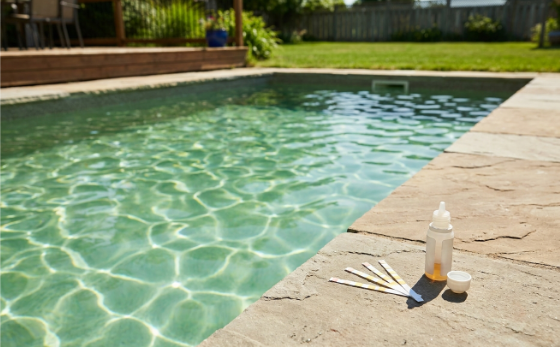

It starts as a faint hint of color. The water still looks mostly clear, but there is something off about it. A slight green undertone that was not there last week. You brush the walls, check the filter, and add a little extra chlorine. Nothing changes.
Most pool owners assume green means algae. But when chlorine levels are normal and the water still has that stubborn tint, the real problem is usually sitting quietly in your test results: your pH is out of range.
pH controls almost everything that happens in your pool water. When it drifts too far in either direction, the chemicals you rely on stop working the way they should. The green tint is just the first visible symptom.
What pH Actually Does in Your Pool
pH is a measure of how acidic or basic your water is, on a scale from zero to fourteen. Pool water should sit between 7.2 and 7.8. Below 7.2, the water is too acidic. Above 7.8, it is too basic.
This range matters because pH directly controls how effective your chlorine is. At a pH of 7.5, free chlorine is roughly 50 percent active. At 8.0, that number drops to about 20 percent. At 8.5, chlorine is barely working at all.
So your test strip might show plenty of chlorine in the water, but if the pH is too high, most of that chlorine is essentially inactive. It is present but powerless.
The Ripple Effects of Wrong pH
- Chlorine loses effectiveness, allowing algae and bacteria to gain a foothold
- High pH causes calcium scale on tile, fittings, and heater elements
- Low pH corrodes metal components and etches plaster surfaces
- Swimmers experience eye irritation and dry, itchy skin
- Cloudy water becomes persistent even with proper filtration
Any one of these issues can be frustrating on its own. When they start appearing together, it almost always points back to a pH that has drifted outside the ideal range.
Why pH Drifts in the First Place
Pools are not closed systems. Every swimmer who enters the water introduces oils, sweat, and sunscreen. Rainfall dilutes your chemistry. Even the type of chlorine you use can push pH in one direction or the other over time.
Trichlor tablets are acidic. They slowly pull pH down with each dose. Liquid chlorine and calcium hypochlorite are basic. They push pH up. If you switch between products or adjust your dosing routine, your pH will shift accordingly.
Aeration is another major factor. Running waterfalls, spillways, or fountains increases carbon dioxide loss from the water, which naturally raises pH. If your pool has decorative water features, you may notice pH climbing steadily over the course of a week.
Getting pH Back Where It Belongs
Before adjusting pH, always test your total alkalinity first. Alkalinity acts as the buffer that keeps pH stable. If alkalinity is low, any pH adjustment you make will drift back within days. Bring alkalinity to the 80 to 120 ppm range, then fine-tune pH.
To raise pH, sodium carbonate is the standard choice. It is fast-acting and effective. Add it in small doses, with the pump running, and retest after four to six hours. Never add more than the calculated dose in a single treatment.
If you want a thorough reference on the entire process, learning how to balance pool pH includes step-by-step dosing instructions, product recommendations, and troubleshooting for stubborn cases.
- Test alkalinity first and adjust if it is outside 80 to 120 ppm
- Test pH and determine how far it needs to move
- Calculate the correct dose of pH adjuster for your pool volume
- Dissolve the product in a bucket of water and pour slowly into the deep end
- Wait four to six hours with the pump running, then retest
Keeping pH Stable Week After Week
The easiest way to manage pH is to prevent it from drifting in the first place. Consistent testing is the key. Check pH at least twice a week during heavy swimming season, and once a week during lighter use periods.
Pay attention to patterns. If your pH always drifts in the same direction, look for the cause. It might be your chlorine source, your aeration level, or the number of swimmers using the pool. Identifying the pattern makes prevention much simpler.
Keep both pH increaser and pH decreaser on hand so you can respond quickly when a test shows a drift. Small corrections of one or two tenths are easy and fast. Waiting until the pH has shifted a full point makes the correction harder and increases the risk of overshooting.
A Quick Weekly Checklist
- Test pH and alkalinity at least twice per week
- Add chlorine at the same time each day to maintain consistency
- Rinse off before swimming to reduce contaminant load
- Run the pump for at least eight hours daily during summer
A pool with stable pH is a pool that practically takes care of itself. Chlorine works at full strength. The water stays clear. Surfaces last longer. Swimmers stay comfortable. The green tint disappears, and it does not come back.
The shift from constant fighting to effortless maintenance starts with understanding that pH is not just another number on the test strip. It is the foundation that everything else is built on.