

Ever paused mid-sentence wondering whether it’s “flies” or “flys”? You’re not alone. This tiny spelling difference trips up a lot of people—especially in phrases like time flies or when talking about planes and insects.
In this guide, we’ll break down the correct usage, explain why “flies” is almost always right, and clear up confusion around common expressions.
Is It “Flies” or “Flys”?
Let’s settle it first: “flies” is correct in nearly all everyday situations.
Why “flies” is correct
“Flies” is the standard third-person singular form of the verb to fly. It’s used when talking about:
- Someone or something flying
- Time passing quickly
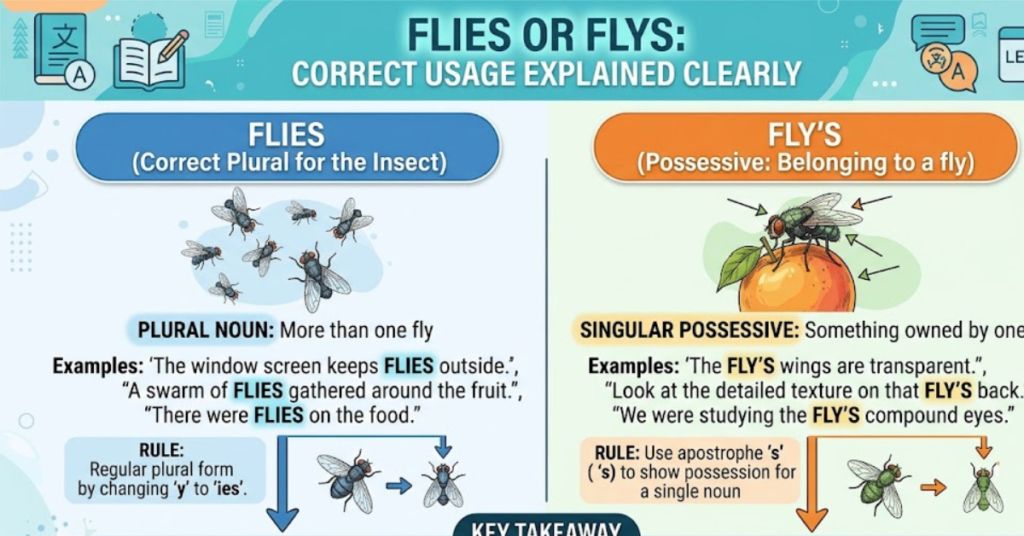
- The plural of the insect fly
Examples:
- She flies to Dubai every month.
- Time flies when you’re having fun.
- There are too many flies in the kitchen.
When Is “Flys” Used?
Technically, “flys” does exist—but it’s extremely rare and mostly outdated. It may appear in specialized contexts, like nautical terminology, but it’s not used in modern everyday writing.
If you’re unsure, stick with “flies.”
Common Phrases
Time Flies
The correct phrase is:
- Time flies
- How time flies
- Time sure flies
These expressions all mean that time passes quickly.
Talking About Planes
When referring to aircraft:
- The plane flies
- The airplane flies
Examples:
- The airplane flies at high altitude.
- A plane flies over the city every hour.
He/She Flies
For people, the same rule applies:
- He flies frequently for work.
- She flies internationally.
“Flies” as a Verb and a Noun
The word “flies” serves two roles:
As a verb
Describes the action of flying:
- The bird flies south for winter.
- The drone flies smoothly.
As a noun
Plural of the insect fly:
- There are annoying flies everywhere.
Why the Confusion Happens
English spelling rules can be tricky, especially with verbs ending in -y.
The rule:
When a verb ends in a consonant + y, change y → ies
- fly → flies
- try → tries
- cry → cries
That’s why “flys” might seem logical—but it’s not correct in standard usage.
Quick Summary
- Flies = correct in almost all cases
- Flys = rare and generally incorrect
If it sounds like natural conversation, “flies” is the right choice.
Read also <<< Anniversary Wishes: Heartfelt Messages for Every
FAQs
1. Is it “time flies”?
Yes, that’s the correct phrase.
2. Why isn’t “flys” correct?
Because verbs ending in consonant + y change to ies.
3. Can “flys” ever be used?
Only in rare, technical contexts.
4. What does “time flies” mean?
It means time passes quickly.
Conclusion
The confusion between these two spellings is common—but easy to fix. In almost every situation, “flies” is the correct choice.
Mastering small details like this can make your writing clearer and more polished. And next time you hesitate, you’ll know exactly which one to use.