

If you’ve ever paused mid-sentence wondering whether to write protestors or protesters, you’re not alone. It’s one of those small but surprisingly common language dilemmas that can trip up even confident writers. The good news? There’s a clear answer—and a bit of nuance depending on where and how you’re writing.
In this guide, we’ll break down the correct spelling, explore usage in different regions like the UK, and explain what style guides such as AP Style recommend. By the end, you’ll know exactly which version to use and why.
Protestors or Protesters: What’s the Correct Spelling?
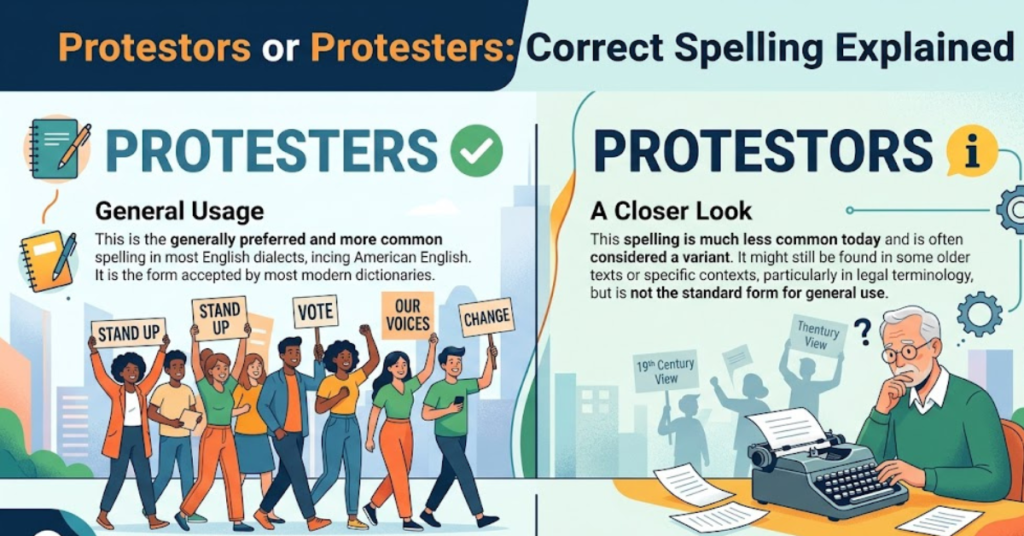
Let’s get straight to it: “protesters” is the preferred and more widely accepted spelling.
While both forms exist, protesters is considered standard in modern English. It refers to people who publicly demonstrate or express opposition, often in social or political contexts.
Why “protesters” is preferred
- It follows common English patterns (like writers, readers)
- It aligns with most dictionaries and style guides
- It’s more frequently used in journalism and academic writing
That said, protestors isn’t technically incorrect—it’s just less common and often avoided in formal writing.
Protestors or Protesters Spelling: What Do Dictionaries Say?
When it comes to protestors or protesters spelling, most major dictionaries list both versions. However:
- “Protesters” is usually listed first
- “Protestors” is often marked as a variant or less common form
In everyday use, especially online and in media, protesters dominates by a wide margin.
Protestors or Protesters AP Style: What’s the Rule?
If you’re writing for journalism or content that follows AP Style, the answer is simple:
Use “protesters”
AP Style favors clarity, consistency, and common usage. Since protesters is the more widely recognized spelling, it’s the recommended choice.
Why AP Style prefers “protesters”
- It reflects standard American English usage
- It avoids confusion for readers
- It maintains consistency across publications
So if you’re asking protestors or protesters AP style, stick with protesters every time.
Protestors or Protesters UK Usage
Now let’s talk about protestors or protesters UK usage.
In British English, the situation is similar:
- “Protesters” is still more common
- “Protestors” appears occasionally but is less preferred
Even though British English sometimes differs in spelling (like colour vs color), this is one case where both UK and US English largely agree.
Is It Protestors or Protesters? A Simple Rule to Remember
If you’re still wondering is it protestors or protesters, here’s an easy rule:
When in doubt, use “protesters.”
It’s:
- More common
- More widely accepted
- Preferred in professional writing
Think of it this way: if you want to sound natural and correct to the largest audience, protesters is your safest bet.
Common Mistakes to Avoid
Here are a few pitfalls people run into:
- Mixing both spellings in the same article
- Using “protestors” in formal or journalistic writing
- Assuming regional differences make both equally common
Quick tip:
Pick protesters and stay consistent throughout your writing.
When Might “Protestors” Be Used?
Although rare, protestors can still appear in:
- Older texts or publications
- Legal or formal documents with traditional language
- Personal writing where consistency matters more than convention
However, for SEO, readability, and professionalism, it’s best to avoid it.
FAQs
1. Is “protestors” incorrect?
No, it’s not incorrect, but it’s less common. Most writers prefer protesters.
2. Which spelling should I use for SEO?
Use “protesters”, as it’s searched more frequently and recognized by search engines.
3. What does AP Style recommend?
AP Style clearly favors “protesters.”
4. Is there a difference in meaning?
No, both words mean the same thing—people who protest.
5. Do British writers use “protestors”?
Occasionally, but “protesters” is still the dominant form in the UK.
Conclusion
The debate over protestors or protesters isn’t as complicated as it seems. While both spellings exist, “protesters” is the clear winner in modern English—especially in journalism, SEO writing, and everyday communication.
To keep your writing sharp and professional:
- Stick with protesters
- Follow AP Style if applicable
- Stay consistent throughout your content
If you’re aiming to write clearly and rank well in search engines, this small choice can make a noticeable difference.